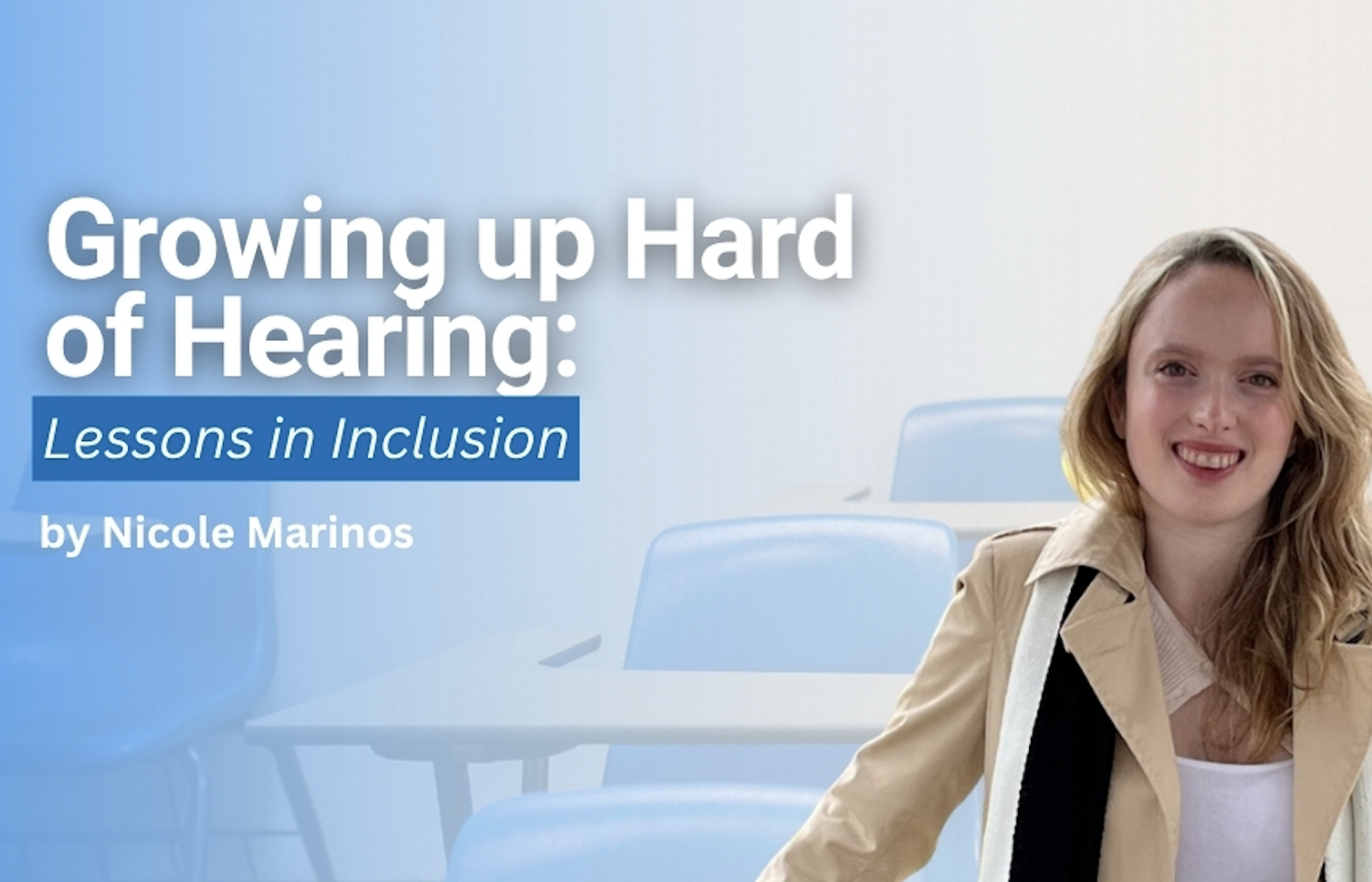
Article written by Nicole Marinos – disability advocate and inclusion professional
I have spent much of my life learning that access can make a bigger difference than people realise. As someone who is hard of hearing, I have experienced environments where I could participate fully, and others where I was physically present but still missing out. The difference was not always my hearing loss. Very often, it was the environment around me.
When I was younger, I attended a mainstream primary school in Ireland where I had access to supports that made a real difference. My classroom was acoustically treated, my teachers had specialist training, and a sound-field system helped me hear more clearly. I was able to focus on learning and being a child, rather than constantly trying to overcome barriers.
That changed when I moved to secondary school. The support available was more limited, and I often relied on an FM system connected to the teacher. It helped, but it did not solve everything. I could still miss questions from classmates, conversations happening around me or information that was not directed towards the teacher.
I remember creating training videos and leaflets to help explain what hearing loss meant and what people could do to make communication easier. At that age, I was already learning that access often depended on whether people understood the barriers in the first place. These experiences have stayed with me. They have also shaped how I think about inclusion today.
Being included is not simply about being allowed into a classroom, a workplace or a meeting. It is about being able to understand what is happening, contribute, ask questions, make decisions and feel that your presence matters.
Sometimes the adjustments needed are quite simple: written follow-up information, shared documents, captions, a quieter space, accessible meetings or making sure that people are not expected to rely on lipreading alone. But these things can determine whether someone feels confident and involved or whether they are constantly trying to catch up.
Assistive technology can be life-changing, but it is not a complete solution on its own. Hearing aids, captioning systems, microphones and other technologies can improve access, but they need to be suitable, available and used in environments where people understand how they work. Most importantly, people with hearing loss should have a say in deciding what support works for them.
This is why European disability rights initiatives matter to me. They help establish that accessibility, participation and equality are not optional extras. They provide direction for governments, institutions and organisations to improve the systems that people rely on. But I also think about the distance that can exist between rights and reality.
A right may be recognised in legislation, policy or strategy, yet a person can still find themselves missing information in a lecture, struggling to follow a workplace meeting or having to explain their needs repeatedly. The real test of inclusion is what happens in those everyday moments.
For me, meaningful inclusion means not having to fight for the same basic opportunity over and over again. It means being able to access education, employment and public life without the environment creating unnecessary barriers. It also means listening to people with disabilities, not only asking us what difficulties we experience, but involving us in designing the solutions. Our experiences can highlight gaps that may not be visible to people who do not encounter them themselves.
I have learned that the same hearing loss can feel very different depending on the environment. In one setting, I can feel confident, independent and fully involved. In another, I can feel exhausted from trying to follow conversations or make sure I have not missed something important.
That is why inclusion needs to be understood as something practical and ongoing. It is not achieved simply by creating a policy or providing a piece of technology. It is achieved when people can genuinely participate.
As Europe continues to develop its approach to disability rights and inclusion, I hope lived experience remains central to that work. The most meaningful progress will be seen when people with disabilities no longer have to spend so much energy explaining why access matters and can instead use that energy to learn, work, contribute and enjoy life.