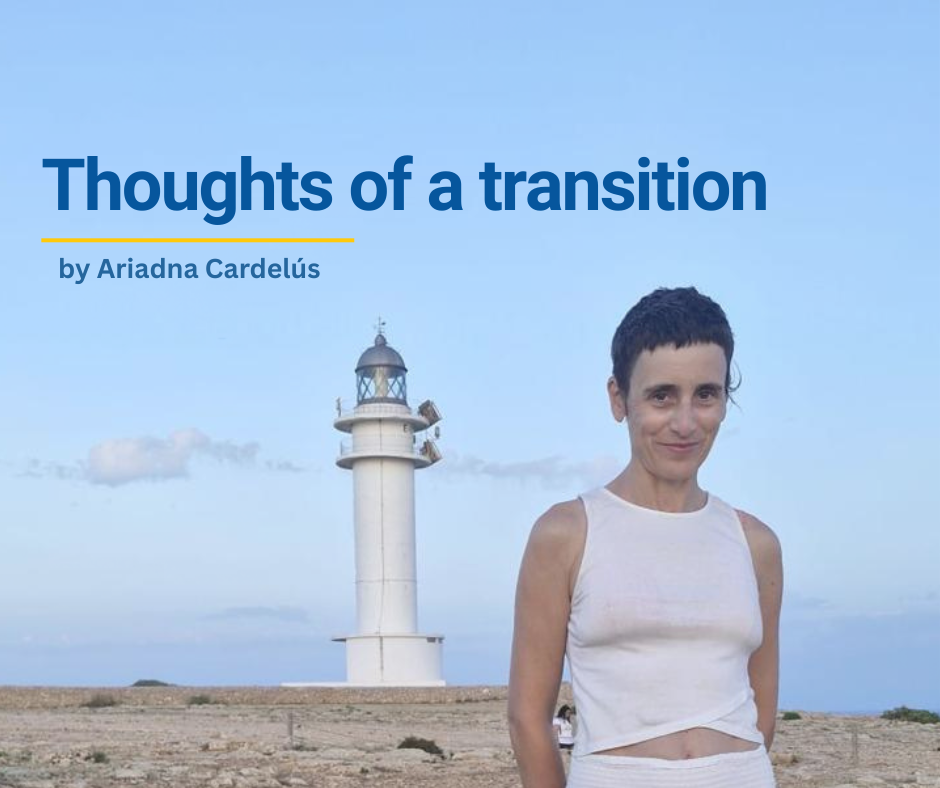
Article written by Ariadna Cardelús – International Relations Officer at ACAPPS
I am sharing my story in the hope that it will contribute to a better understanding of hearing loss and deafness.
From a very young age, I felt a strong passion for music, which led me to complete my piano studies at the Liceu Conservatory in Barcelona. I graduated in Political Science and went on to obtain a PhD in Law. Yet, for all my achievements, the greatest challenge was still to come: losing my hearing.
Up until that point, words had always arrived effortlessly, just like that, just as they do for any hearing person.
Little by little, that fluency began to fade. It is difficult to pinpoint the exact day, but I can still vividly recall the moment and the chill that went through me when, at the age of 27, I was diagnosed with bilateral sensorineural hearing loss. At the time, I couldn’t fathom that I was about to embark on the greatest challenge of my life.
Words no longer reached me, nor did musical notes. I could no longer understand what was being said on television, let alone on the radio. I could no longer follow a conversation. I withdrew into a strange, unfamiliar silence I had never experienced before, hiding from reality and denying what was happening. I kept pushing on until the progression of my deafness made it impossible to carry on that way.
When my first daughter, Arlet, was born, I decided to get hearing aids. I could hear sounds again, but I still could not make out words. To understand, I need to lip-read. If I cannot see the lips, I need subtitles.
And yet, I still take enormous pleasure in playing the piano. Thanks to technology, I can hear the notes — in a very different way, but I can hear them, and that moves me deeply. I play more slowly now, but with undiminished passion.
Music is a place where I can almost forget about my hearing loss. Outside that space, however, the lack of accessibility and awareness puts me to the test every day and takes an enormous emotional toll.
On this obstacle-ridden journey, I have had to take on two very different challenges:
- one is accepting that I am part of a new community — the hard of hearing community — while living in a hearing community;
- the other is explaining that I have an invisible disability and very specific needs.
It was in this context that I became involved with ACAPPS, the Catalan Federation and Association of Families and People with Deafness, which works to promote the inclusion of hard of hearing people. I am currently Vice-President of the Association and a member of the Federation’s International Relations Committee. I am actively involved in political advocacy at both the Catalan and European levels through EFHOH (the European Federation of Hard of Hearing People), which does outstanding work promoting and raising awareness of the rights of people with hearing loss across Europe.
All this has helped me move forward and come to accept my hearing loss, but above all, it is my family’s support that has given me — and continues to give me — the strength to find my place in a hearing world. My second child, Marçal, has only ever known me as hard of hearing from the very first day of his life.
I would like to end with a very simple message: hard of hearing people exist, and it is compatible with speaking and with living a full life. And this is precisely where accessibility comes into play.
Accessibility is more than a right; it is what makes the difference and what allows us to be included — to be part of society: to work, enjoy culture, participate, go out with friends and spend time with our families. Unfortunately, as things stand today, we are still a long way from full accessibility. And it is in this context that I ask myself a number of questions:
- Why is it so difficult for society and institutions to understand the needs of deaf and hard-of-hearing people?
- Why do so many people say to me that I “don’t look deaf”, as though they were paying me a compliment?
- Why are there so many deaf and hard-of-hearing people in Europe, and so little accessibility?
We need both technological accessibility and human accessibility. We need a society where people help us, look us in the face, show a little patience and walk alongside us. Where they understand that we may not always do things as quickly, but that we can still do them — and that, ultimately, we can understand everything.
With both forms of accessibility, we can get wherever we set our mind to. One depends largely on financial resources —it requires public investment— but the other depends entirely on people’s willingness to help. By understanding the needs of people with hearing loss, hearing people can realise that they are key to making our inclusion possible.