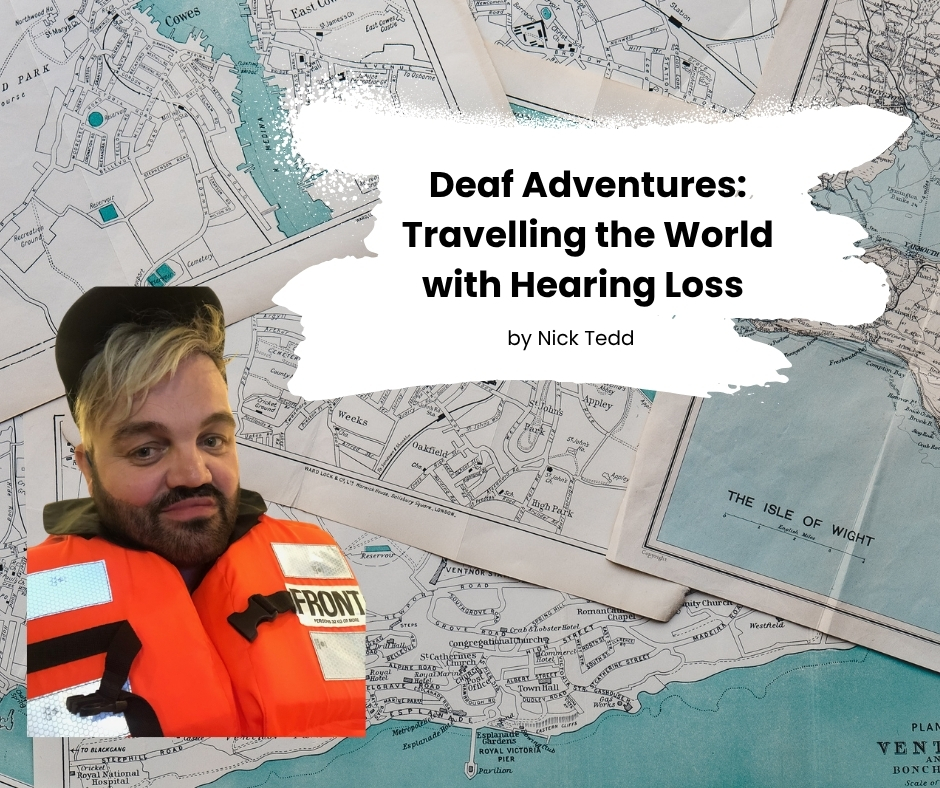
Article written by Nick Tedd – Deaf and hard-of-hearing traveller, accessibility advocate and urban explorer
Travel has always been a big part of my life. I see myself as an adventurer and urban explorer, and my hearing loss has never stopped me wanting to see what is around the next corner.
I’ve travelled extensively, often solo, through the UK, Europe, the United States and further afield. I’ve travelled by plane, train, taxi and cruise ship, stayed in countless hotels and found myself in places where I don’t speak the language as well as places where, technically, I do.
And sometimes being deaf has made those adventures considerably more complicated.
The biggest barrier isn’t always hearing
One of the most important things travelling has taught me is that I am not the problem — the barrier is the problem.
Sometimes that barrier is a tannoy announcement I cannot understand. Sometimes it is an airport employee talking to me while looking away. It might be information that is only provided verbally, a hearing loop that doesn’t work, a safety announcement without a text alternative, or somebody simply not understanding what I need.
There have been times when those situations have left me feeling isolated, vulnerable or frustrated.
But there have also been many occasions when somebody has listened, adapted what they were doing and made an enormous difference with one very simple action.
That has taught me something else: being specific about what I need really matters.
Rather than simply saying, “I’m deaf”, I explain what will help me.
I might say that I lipread, ask somebody to face me, request information in writing or explain that I won’t hear an announcement and need someone to tell me personally if something changes.
It shouldn’t always be our responsibility as deaf and hard-of-hearing people to educate others, but I have found that clear communication can turn a potentially difficult situation into a positive one.
Technology has changed how I travel
My smartphone is probably now one of my most important pieces of travel equipment.
Airline and railway apps, live departure information, text and email alerts, live captions in iPhone, maps and written communication all give me access to information that might otherwise only be announced over a loudspeaker.
My hearing technology comes too, along with spares and backups. I prepare before travelling because losing or damaging something essential when I am thousands of miles from home isn’t a situation I particularly want to test!
Preparation gives me independence.
Before travelling I look at accessibility information, make my access requirements known where appropriate and check how I can receive important information visually.
I also arrive early. Travel is stressful enough without discovering that something has changed and everyone else heard the announcement except me.
Invisible disability is still misunderstood
One of the recurring difficulties with hearing loss is that other people cannot necessarily see it.
I have experienced this at airports, in hotels and on public transport. I’ve sometimes had to explain why I need assistance or why I need to be closer to somebody speaking when, outwardly, I may not fit another person’s idea of what disability looks like. I’m 6’ 4” & have worked in the looks business for 45 years (I’m a hairdresser & have my own business).
Experiences like these can knock your confidence.
But they have also made me a much stronger self-advocate.
I’ve learnt that asking for access isn’t asking for special treatment. It is asking for the information or adjustment I need to have the same opportunity to travel safely and independently as everybody else.
And when something isn’t accessible, I increasingly speak up about it.
Not simply for myself, but because the next deaf or hard-of-hearing traveller may benefit from that conversation.
My best travel advice? Advocate for yourself
If I could give another deaf or hard-of-hearing traveller a few pieces of advice, they would be simple.
Tell people what you need. Don’t assume that because you mentioned your hearing loss when booking, the information will necessarily have reached the person standing in front of you.
Use the technology that works for you and have backups.
Look for visual information rather than relying on announcements.
Allow yourself more time.
And don’t be embarrassed about asking somebody to repeat themselves, face you, write something down or communicate differently.
Most importantly, don’t allow one bad experience to define travelling with hearing loss.
I’ve misunderstood things. I’ve missed announcements. I’ve encountered people with very little deaf awareness and found myself in situations where I’ve felt extremely vulnerable.
But I’ve also met some wonderful people, experienced extraordinary places and developed a confidence through travelling that has carried over into the rest of my life.
Hearing loss won’t stop me
Travelling with hearing loss has given me confidence, independence and a much clearer understanding of what good accessibility actually looks like.
I’m still travelling.
I’m still learning.
And I’m still occasionally standing somewhere wondering what on earth has just been announced over the tannoy!
But I’m also much clearer about what I need and much more confident about asking for it.
For me, accessible travel isn’t about somebody doing everything for me. It is about having information and communication provided in a way I can access, so that I can make my own decisions and retain my independence.
There is still a great deal of work to be done, particularly around deaf awareness and providing visual alternatives to spoken information.
Every time we speak up, ask for an adjustment or point out a barrier, there is an opportunity for things to be a little better for the next deaf or hard-of-hearing person who comes along.
I’m just about to take my next solo adventure to New Orleans, Memphis & Minneapolis, so watch this space!
Hearing loss has not made my world smaller. If anything, travelling has helped make it bigger.
Nick Tedd
Deaf and hard-of-hearing traveller, accessibility advocate and urban explorer