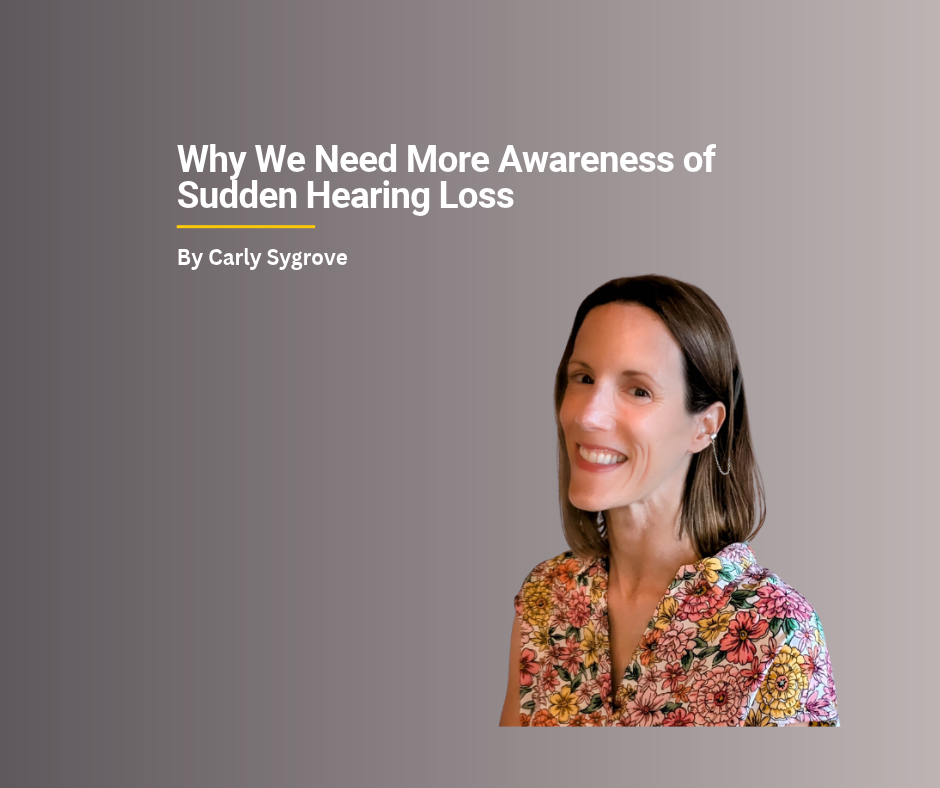
Article written by Carly Sygrove – hearing loss coach, writer and hearing health advocate.
I waited eight days before I saw a doctor after suddenly losing all the hearing in my left ear. I didn’t know that sudden hearing loss is a medical emergency and that prompt treatment offers the best chance of regaining hearing. Why would I? I’d never even heard of sudden hearing loss until it happened to me.
And, unfortunately, it wasn’t just me who didn’t recognise the emergency. My doctor didn’t either.
I’m originally from the UK, but I was living and working as a teacher in Madrid, Spain, when I lost my hearing. It was a teacher training day, and I was sitting in a school auditorium, listening to a guest speaker give a presentation. I lifted my head from writing some notes, and suddenly my surroundings began to spin around me. There was a loud screeching sound in my ears. This was the moment the world to the left of me fell into silence.
At the time, my attention was more on the vertigo and the screeching than on the blocked feeling in my ear and the fact that I seemed to be having trouble hearing. I just thought I’d feel better after a good night’s sleep.
Eight days later, I finally went to see my doctor. There was no visible sign of my hearing loss when she looked inside my ears. She suggested there might be some inflammation and sent me home with ibuprofen and a nasal spray, telling me to return if I still couldn’t hear after a week.
A week later, I was back in her consultation room. She referred me to an ear, nose and throat (ENT) specialist, and it wasn’t until day 18 that I had my first hearing test, which revealed a profound hearing loss in my left ear. This was the day my treatment began, but by this point, the delay may have reduced my chances of recovery.
My hearing never returned.
Sudden sensorineural hearing loss (SSNHL) is a rapid loss of hearing that develops over 72 hours or less and involves the inner ear or hearing nerve. It often affects just one ear and may be accompanied by tinnitus, dizziness or a feeling of fullness.
The standard treatment is typically corticosteroids, given orally or through injections into the middle ear. Sudden unexplained hearing loss requires urgent medical assessment, ideally within 24 hours. Corticosteroid treatment is generally most beneficial when started early, particularly within the first two weeks after hearing loss begins.
However, prompt treatment doesn’t guarantee that hearing will return. Some people recover fully, others partially, and some, like me, are left with permanent hearing loss.
Sudden hearing loss can be life-changing. There’s no time to prepare for the abrupt change in how you hear and experience the world around you. There are the practical challenges of communicating with others, but there can also be an emotional impact. In my case, I experienced the initial shock and later realised I was grieving my lost sound and the future I’d thought I’d have, one where I wouldn’t have to navigate life with reduced hearing. I lost confidence in myself, as the hearing I’d lost had played a part in the way I interacted with people and my surroundings. I now felt unsure of myself in situations that had once felt familiar.
There can also be a lot to learn, such as how to explain your hearing needs to friends, family and colleagues, and finding ways to continue doing the things you enjoy. For some, there’s also the challenge of living with tinnitus or balance problems.
My hearing loss made an advocate out of me.
Over the past ten years, I’ve become passionate about raising awareness of sudden hearing loss and the importance of prompt treatment. And that awareness needs to extend beyond the general public to the medical community too.
Even if a doctor recognises the warning signs, what happens if the receptionist answering the phone doesn’t? Someone experiencing sudden hearing loss might be offered a routine appointment several days later, potentially missing an important opportunity for treatment.
Through my advocacy work, I’ve connected with hundreds of people who have experienced sudden hearing loss. Ten years on, I’m still hearing from people with stories just like mine. People who were told to wait and see. People whose symptoms were mistaken for a blocked ear or an infection. People who waited weeks, sometimes months, for an ENT appointment.
We need to keep talking about sudden hearing loss and raising awareness, not just among the general public, but throughout the healthcare system. Receptionists, general practitioners (GPs), pharmacists and other frontline healthcare workers need to recognise the warning signs and know how to direct people towards urgent medical care.
And for those whose hearing doesn’t recover, there needs to be access to reliable information, practical guidance and emotional support.
Ten years ago, when I sat in that school auditorium and suddenly lost the hearing in my left ear, I had no idea that I was experiencing a medical emergency.
I hope that with more awareness and education, fewer people will find themselves in the same position I did.